Prescribed precision digital therapeutics
Intelligent care that builds you up.
DancingMind turns prescribed therapy into gamified programmes on VR and tablet: precision digital therapeutics, graded like strength training and delivered wherever care happens. We're building towards fully remote, automated therapy that grows along with you, guided by in-app data and, with research partners, brain–computer interface monitoring.
A woman in a grey tracksuit walks in side profile through slowly changing virtual worlds — a coral reef, a snowy forest, a mountain lake — wearing a DancingMind VR headset.
Illustrative session metrics, for example: session 12 · reaction time +9% · attention steady.
Trusted by hospitals, health systems and community-care partners
Singapore


United Kingdom

Research frontier
Closing the loop between brain and therapy
With research partners, we've prototyped an integrated BCI and VR headset that brings brain–computer interfaces directly into VR therapy, measuring the brain during the session, not after it.
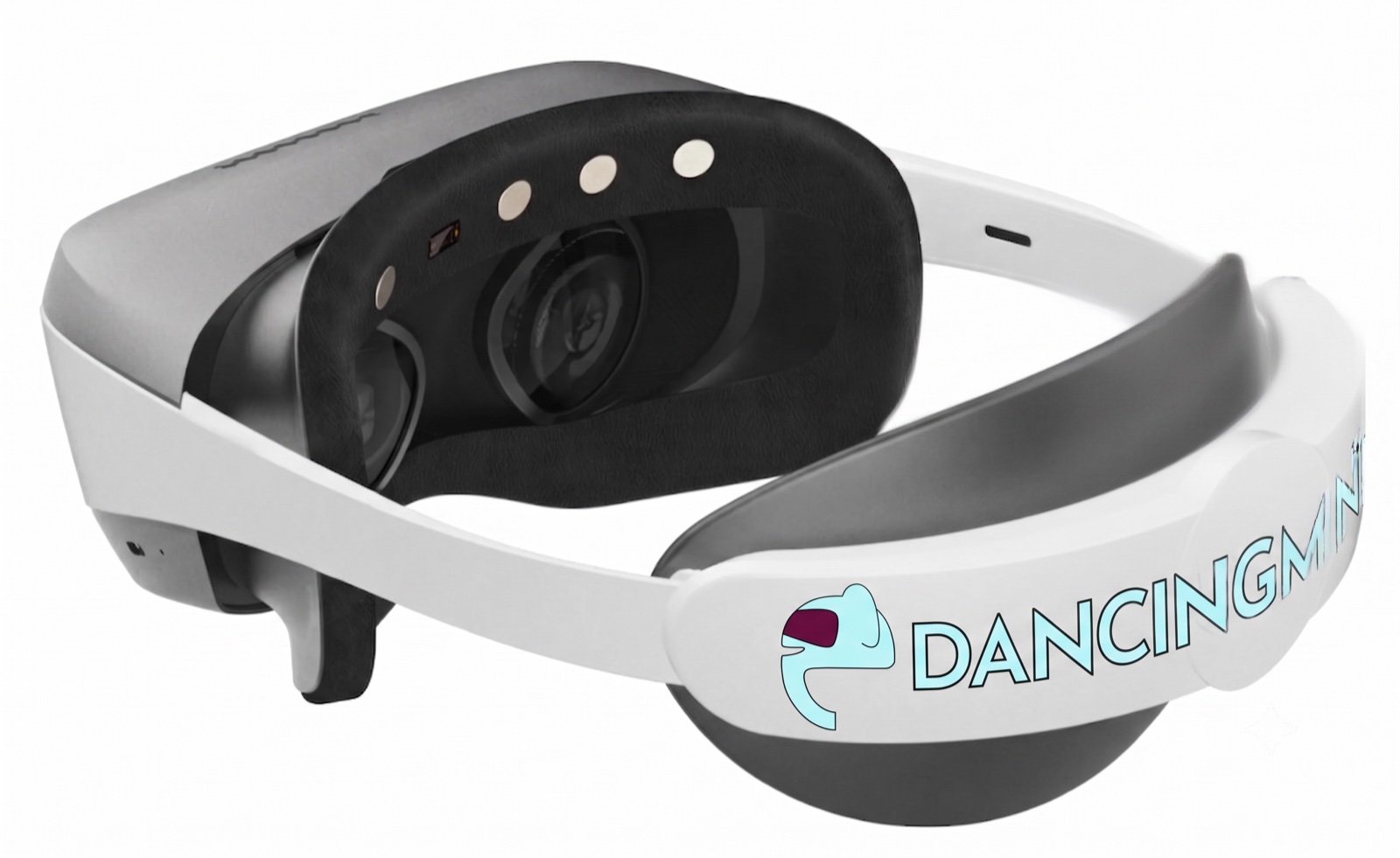
Drag to rotate · tap a dot to inspect
01
Prove the why
Mechanistic validation of why immersive therapy drives the outcomes our trials already show.
02
See the session
Live mapping of attention, mood and engagement while a patient trains.
03
Forecast recovery
The more a patient trains, the more precisely we can project expected gains, by domain and over time, and focus therapy on the areas that need it most.
In prototype with research partners; not part of the commercial platform today.
Track record
Adopted at national scale.
Hospitals, patients and governmental bodies alike trust DancingMind, across Singapore and the United Kingdom.
70%+
Of Singapore's restructured hospitals
Run DancingMind programmes, alongside NHS trusts and care partners across the United Kingdom.
90%+
Of patients report improvement
In cognitive function, physical function or mood, in post-programme feedback across deployments.
30+
Grant-funded programmes
Delivered with national grant support at minimal or no cost to community partners, and counting.
Adoption and feedback figures across deployments. Clinical outcomes are reported separately, with study context, in the evidence library.
Who benefits
Clinicians
treat more patients at once, without more admin.
Patients
recover faster, with rehab they actually enjoy.
People with special needs
build skills and independence.
Seniors
keep active and relearn life skills.
Healthy individuals
stay sharp and stay well.
The gap in care
Demand for therapy keeps growing. Delivery hasn't kept up.
Medication has limits
Pharmaceutical treatment brings side effects, and for many neurological and developmental conditions there is no effective drug at all.
Conventional therapy doesn't scale
Therapists are scarce, sessions are costly, and care happens only inside hospitals and clinics, so most patients get far less therapy than they need.
Adherence undermines both
Outcomes depend on sustained, repeated practice. When therapy is dull, distant or expensive, patients stop, and progress stops with them.
The therapy works. The delivery model is what's broken. So that's what we rebuilt.
Our philosophy
Keep the brain where it changes most.
Every programme is built on four principles about how brains rewire.
01
Immersion raises plasticity
VR commands attention and engages the senses like nothing else, creating the intensity of stimulation where neuroplasticity, the brain's capacity to rewire, is at its greatest.
02
Every app is a precision tool
Each application targets a specific function, so therapy can exercise and modulate the exact areas that need work: attention, memory, movement, speech or mood.
03
Watch the session live
Performance is monitored in real time, through in-app data and, in research, BCI signals, so the programme can intervene the moment it should, not at the next review.
04
Hold the productive edge
An adaptive model keeps each patient at their highest sustainable level of stimulation and challenge: enough to drive change, never so much that it overwhelms.
The application library
Four domains. One adaptive library.
50+ gamified therapy applications, designed with clinicians and delivered on standalone VR headsets and tablets.
Cognitive
Brain health
Memory, attention and executive function: standardised cognitive training that tracks performance in-game.
e.g. Sustained-attention training with eye tracking.
Physical
Physical health
Physiotherapy and sports-rehab modules that turn prescribed repetitions into gameplay.
e.g. Upper-limb rehab through fishing and darts.
Daily living
Independence
Real-world activities practised safely in immersive environments, building skills that transfer back into daily life.
Mood
Psychological health
Mindfulness, relaxation, music therapy and CBT-based scripts for anxiety, low mood and sleep.
Both sides of a session
What they do, and what they see.
A therapy session looks gentle from the outside: soft, repeated movement. Inside the headset it's a world worth moving for. Drag the divider to see both at once.
Side by side: in the room, a woman in a grey tracksuit takes slow, steady steps wearing a DancingMind headset; inside the headset, she is walking through the world the session plays, a coral reef or an aurora-lit trail.
Same session, both views. Telemetry shown is illustrative, not patient data.
How it works
Like strength training, for mind and body.
Every programme starts with in-app baselines: standardised screens and motion tracking establish where each patient is today.
Therapy is delivered as games people genuinely enjoy, so the sessions that drive recovery actually happen, week after week.
Difficulty is graded like progressive overload: as a patient improves, the programme adds just enough challenge to keep them growing.
Every session captures granular performance data, giving clinicians a live picture of recovery and focusing therapy where it's needed most.
Where we fit
Built for the care system, and beyond it.
Hospital
Hospitals & health systems
Clinician-prescribed programmes, group-session software and monitoring dashboards that extend therapist capacity, in use across more than 70% of Singapore's restructured hospitals and with NHS partners in the UK.
Partner with us →Community
Community & aged care
Active-ageing centres, senior day-care and nursing homes run DancingMind group programmes, with many deployments supported by national grants at minimal or no cost to centres.
Bring it to your centre →Home
Patients & families
Referred through your hospital or care provider, therapy continues at home on the same platform, monitored remotely by your care team.
Talk to us →Who we help
From first school years to healthy ageing.
The same adaptive platform, tuned to very different lives.
Children & young people
Attention, communication and developmental-skills training delivered as play, in use today with children with ADHD, autism and global developmental delay.
Adults with intellectual disability
Safe, repeatable virtual environments where people learn job tasks, practise routines and explore with confidence before doing it for real.
Older adults
Group cognitive training, physical rehab and mood programmes across hospitals, active-ageing centres, nursing homes and living rooms.
Clinical evidence
Published, peer-reviewed, and honest about what's proven.
35%
Faster motor recovery
Versus standard care, in a randomised controlled trial with National Healthcare Group partner hospitals, Singapore, 2024.
2–3×
Improvement in group sessions
Versus one-on-one therapy (active control), in older adults with mild cognitive impairment.
22%
Improvement in attention span
In children with ADHD.
Results from specific studies in specific populations. See the evidence library for full context.
Efficacy is demonstrated in randomised controlled trials with partner hospitals. The neural mechanisms of why immersion works are still under active study. That's what our BCI research programme is for.
Featured publication
MindGym feasibility RCT in mild cognitive impairment
With Changi General Hospital, published in the Annals Academy of Medicine Singapore.
Read the summary →As featured on CNA
Watch us on On The Red Dot
See how seniors and patients use DancingMind at home and in the community.
In their words
We help forge successes.
From the seniors, patients and therapists who use DancingMind, as they told us.
“I really like MindGym! It helps me forget all my troubles and worries.”
「我非常喜欢MindGym这个项目,因为让我忘却了所有的烦恼。」
SK Ng, 83
MindGym cognitive-training participant
“After using VR, I felt really excited! I've never experienced something so interesting. The songs and views are mesmerising, it's like I'm travelling abroad. I've experienced pretty bad injuries in my hands and legs, but after using the Ball & Glove app, I couldn't believe that I could still do boxing!”
「用了VR后,我感觉很兴奋,因为我从来没有体验过这么新奇的东西!歌曲很好听,里面的风景也很美,像在出国旅行。」
YY Chong, 68
Physical-rehabilitation participant
“Able to help me focus and react. Makes me think also. I'm excited to do more so I can improve!”
Mdm RB, 80
Wheelchair-bound and once lethargic, Mdm RB stretched her neck further in a DancingMind physiotherapy module than her therapist had ever seen — and now starts conversations with a radiant smile.
“It was the first time he moved his toes since the accident!”
Harry’s care team
Paralysed from the neck down after a harrowing accident, Harry moved his fingers to the beat of the music — and then, to cheers from the therapists and doctors at his bedside, his big toe.
From the therapy floor
“This is easy to use”
“Will help me greatly to engage difficult patients”
“Exactly what I wanted in innovative therapy”
— Physiotherapists and occupational therapists running DancingMind sessions
Individual experiences shared by participants and therapists, as previously published; outcomes vary. Clinical results, with study context, live in the evidence library. Browse the evidence
Recognition
Recognised across the care sector.
Awards from the eldercare and health-innovation community, cited as conferred.
2020
Innovation of the Year — Health Programme
8th Eldercare Innovation Awards
2024
Corporate SME category
CommunityCare Friends Awards
Recognised for innovation
SingHealth innovation awards
From the team
Latest
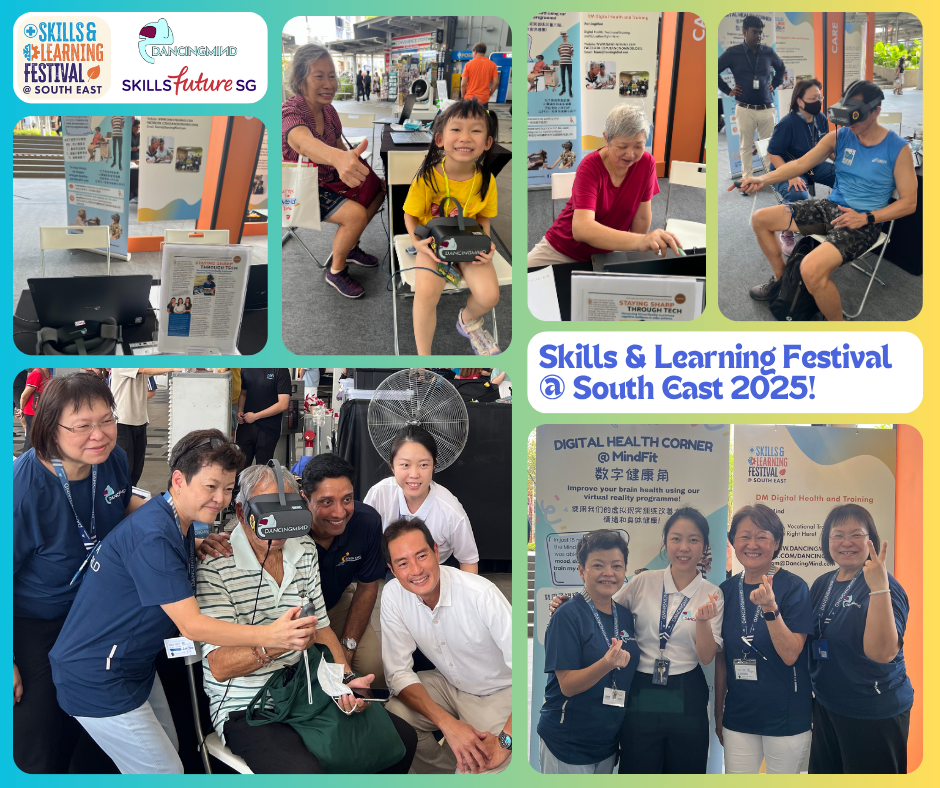
Bring DancingMind to your setting
Active-ageing centre, hospital ward or day-care: see the platform running with your population, in person or remotely. Many community deployments qualify for grant support.